Clay, Cast Iron, Orangeburg: A Homeowner’s Guide to Sewer Pipe Materials
The best predictor of your sewer line’s future is what it is made of. Each material fails in its own way, on its own schedule. Here is the field guide to what is likely under your home — and what the camera is looking for in each.
Clay tile (vitrified clay pipe)
The classic. Short rigid sections — typically two to three feet — joined with mortar or rubber gaskets, standard from the early 1900s through the 1970s and the default under most Cerritos-cluster homes. The pipe itself is nearly immortal; the JOINTS are the story. Every few feet is a seam that soil movement opens and roots invade. On camera, clay shows as segmented pipe with root hairs or masses at the seams, offset joints, and occasional cracks running along a section. Verdict pattern: sound sections, failing joints — a lining candidate when alignment holds.
Cast iron
Heavy, durable, and standard for homes from the early-to-mid 1900s (and still used inside houses). Cast iron’s failure is internal: decades of flow rust the inside from the bottom up — ‘channeling’ — until the bottom of the pipe thins, scales, and eventually wears through, letting waste leak into the soil. On camera it shows rough, tuberculated walls, visible rust scaling, and in end stages a missing bottom channel. In this area’s soils, 50-70 years is a typical service life. Verdict pattern: corrosion along the run argues for replacement or lining before the bottom goes.
Orangeburg (bituminous fiber pipe)
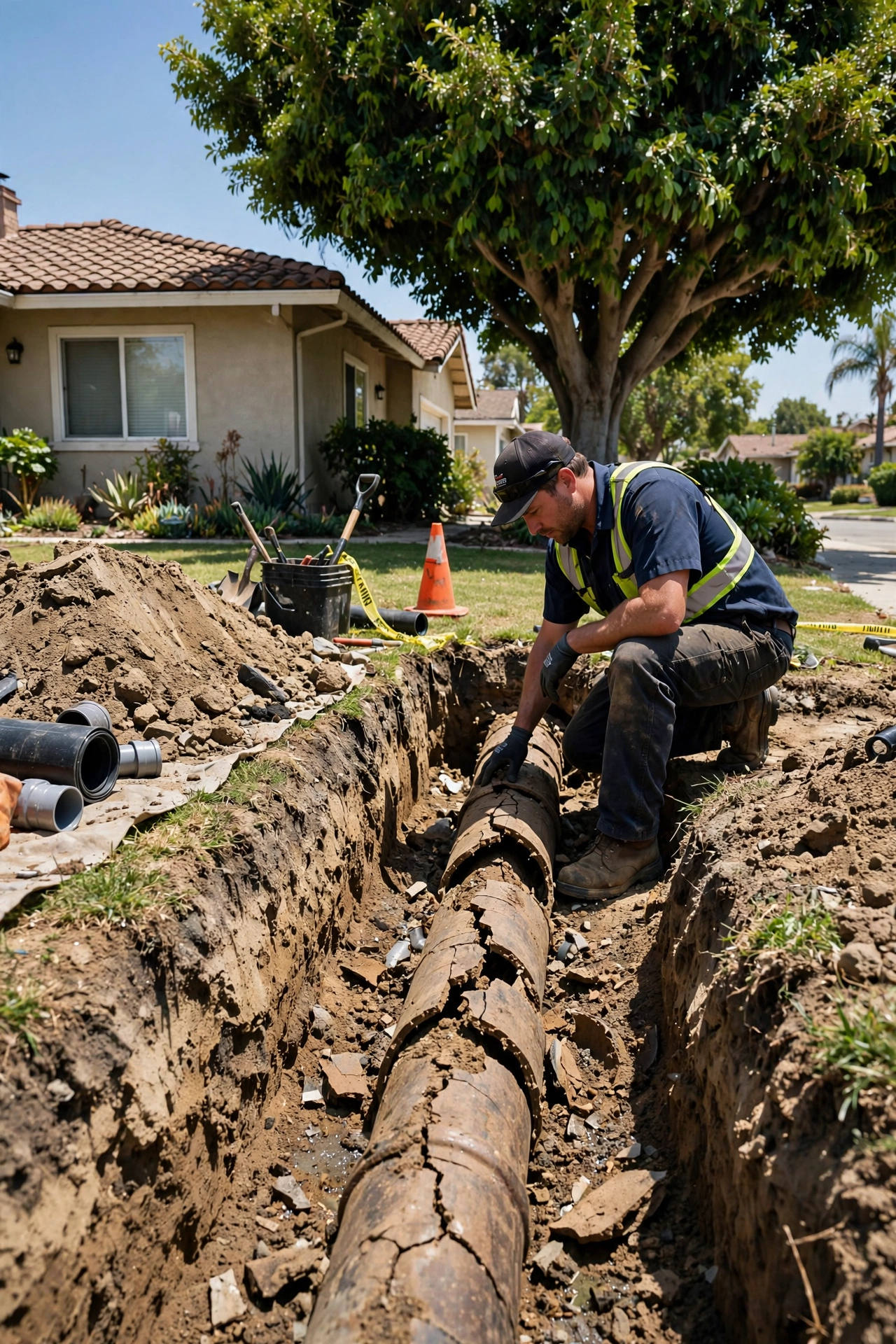
The problem child. Made of wood pulp and pitch, Orangeburg was a wartime substitute used roughly from the 1940s to the early 1970s and still turns up in some older neighborhoods. It was never meant to last this long: it softens, blisters, delaminates and deforms into an oval under soil load, so it clogs constantly and cannot be properly cleaned or lined. On camera it is often visibly out-of-round with a blistered interior. Verdict pattern: replacement, nearly always — it is a material past borrowing time. If your home is from that era and the material is unknown, a camera survey that identifies Orangeburg is money very well spent.
ABS and PVC (the modern plastics)
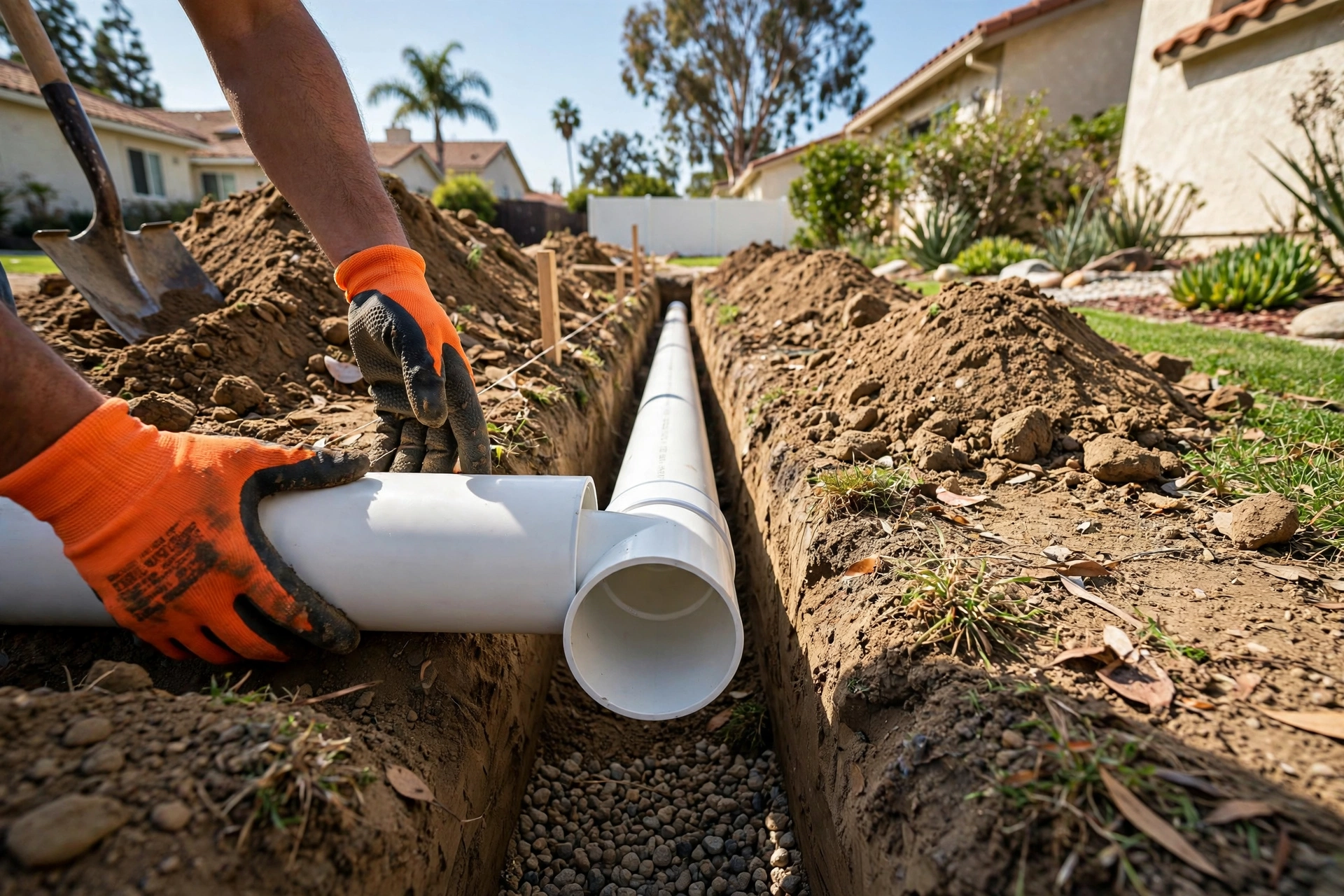
Black ABS and white PVC became standard from the 1970s onward and are what new laterals are installed with today (along with HDPE for bursting). Smooth walls, solvent-welded or gasketed sealed joints, no corrosion, and roots have no seams to exploit. Their failures are installation failures — a belly from poor bedding, a joint that was never glued — rather than material decay. On camera they show clean and round. Verdict pattern: fix the installation defect; the material itself has decades left.
Concrete pipe
Found in some older and larger installations: strong but heavy, with joints that share clay’s root-and-shift vulnerabilities, and interiors that can roughen with age and hydrogen sulfide exposure. Less common under single-family homes in this cluster, but it appears. Verdict pattern: joint-driven problems, similar logic to clay.
How to find out what you have
Three ways. Home age gives a prior: pre-1970s in this area usually means clay, cast iron, or (danger) Orangeburg. Building records and prior repair invoices sometimes name the material. But the definitive answer is a camera inspection — the operator identifies material, condition and joints in one pass and you see it yourself. Material plus condition is exactly the input the repair-or-replacement decision needs.
Most likely clay tile for the yard run, possibly with cast-iron sections — and a small but real chance of Orangeburg depending on the builder and city. That uncertainty is common, and it is precisely what a camera inspection resolves in one visit.
Yes; spot repairs tie new PVC into old clay with shielded flexible couplings made for exactly that transition. Mixed-material laterals are the norm in older neighborhoods that have seen decades of sectional repairs.
PVC or HDPE are the standard modern choices — smooth, sealed, corrosion-proof, and root-resistant at the joints. Your professional will specify the material in the written scope; both are excellent compared to what they replace.
Related Services & Guides
Have This Problem at Your Home?
Guides explain the problem — a camera shows whether it is yours. One call connects you with an independent local sewer professional in the Cerritos area.
Call (888) 555-0199 →Get in Touch with Us
The fastest way to reach a local sewer professional is by phone. Prefer to write it down first? Send the short form — describe what you are seeing, where, and since when.